




Seller Guide
How to Sell Pre-Owned Appliances
If you have a new or gently used refrigerator, range, oven, dishwasher or other appliance that you no longer need, this guide will help you resell it, whether your goal is saving hassle, maximizing earnings, clearing space quickly or all of the above. You'll learn how to identify, price and list your appliance in the right venue for your needs, and how to get it shipped or delivered once it sells.
Overview
Pre-owned appliances are a popular resale category. High-quality appliances, especially from luxury brands, can have a big impact on the perceived value of the spaces they occupy. Buying secondhand gives home and business owners a way to raise the value of their properties without breaking the bank. Before you can sell an appliance, there are a few things you'll need to do.
Step 1
Identify Your Appliance
If you have documentation or an invoice for your appliance, that's a great place to start. Beyond the make and model number, it's also good to check the serial number, so you can confirm that your unit matches the documentation you have. Every appliance has a rating label, also called a serial plate, that shows its model number and serial number. Many labels also show the manufacture date. If yours doesn't, you may be able to find it by searching online for the model and serial number, or by contacting the dealer. Where the label is depends on the type of appliance:
- Refrigerators and freezers: inside, on a side wall or the ceiling, or behind the grille at the bottom.
- Dishwashers: on the edge of the door or the side of the tub.
- Ranges and cooktops: behind the storage drawer, under the cooktop, or on the back.
- Wall ovens: on the frame, where you can see it with the door open.
- Washers and dryers: inside the door, or on the back.
- Appliances still in the box: on the label on the carton.
Once you've identified the exact model number, you're ready to move on to pricing research.
Step 2
Estimate What It's Worth
How to determine the right price for your appliance.
If you know the price you paid for the unit, and you bought it recently, you can use that price as your retail comparison price. That said, you should look online to find out the current market price for similar units in the same condition.
Note whether retailers include shipping, delivery or installation in their price. Also check what warranty the product came with, and whether you'll be able to transfer it to the new owner (often not). Because your unit likely won't come with these add-ons, you'll need to account for them in your discount.
If your item is relatively unique, you'll need to estimate what a buyer would be willing to pay for it based on similar units. To give you a sense of pre-owned price points, here are some appliances we've sold:
| Appliance | Condition | Retail | Sold for |
|---|---|---|---|
| Gaggenau 30" freezer column | New, unused | $9,599 | $6,719 |
| Thermador 36" refrigerator, panel-ready | New, unused | $8,499 | $5,949 |
| Fisher & Paykel 30" column refrigerator | Excellent | $7,699 | $5,389 |
| Wolf 30" built-in wall oven | Good: some wear | $5,969 | $4,476 |
| Sub-Zero 24" outdoor refrigerator | Open box | $3,935 | $2,893 |
| Wolf 36" six-burner rangetop | Excellent | $3,350 | $1,975 |
| Front-load washer, everyday brand | Excellent | $1,149 | $496 |
| Electric dryer, everyday brand | Excellent | $1,149 | $469 |
| 30" gas cooktop, mid-range brand | Good: some wear | $1,199 | $521 |
Brand quality
The general pattern we see is that high-end appliances tend to hold their value better (discounts of about 25–40%), whereas everyday brands need larger discounts (about 55–60%). Mid-market and lower-end brands can often be found on sale, so buyers have less incentive to pay high prices for pre-owned ones.
Age and condition
Age and condition also affect the price. Buyers check the manufacture date, and newer appliances sell more easily. Appliances that were never installed, or only lightly used, sell best. A working appliance with some wear can still sell well if it's from a high-end brand. An appliance that doesn't work is rarely worth listing, unless it's a high-end model that a repair would restore.
Other things that affect the price
- Warranty details. An appliance that was never installed may never have been registered. Check the manufacturer's terms, and say clearly in your listing what coverage remains, if any. Some coverage lasts longer than the standard warranty, such as the warranty on a refrigerator's sealed cooling system. A transferable extended warranty adds value.
- Missing parts or paperwork. If anything is missing, lower your price; see Step 4.
- Discontinued models. These can be harder to sell, because buyers worry about finding replacement parts.
Shipping cost
Large appliances are too big to ship as parcels, so they go by freight, and freight is expensive. Quotes we've received to deliver a single refrigerator or oven to a home ranged from about $375 within a region to $650–$1,100 across the country, and more for Alaska and Hawaii. If your appliance is worth less than a few thousand dollars, freight takes too large a share of the price, so a local buyer who collects it is usually the better sale. Retailers often deliver for free, so a buyer who has to pay for freight also expects a lower price.
In summary
- A high-end appliance, new or slightly used, is usually worth selling.
- A working everyday-brand appliance may be a good fit for reselling locally, where it can be picked up or delivered without the cost of freight shipping.
- If your appliance is older or has significant damage, you might consider donating it. For details, see what to do with appliances that won't sell.
Step 3
Where to Sell Appliances
The best place to sell depends mainly on what your appliance is worth, because that decides whether it's worth paying to ship. These are the main options:
- Local buyers. A local marketplace suits most everyday appliances. The buyer collects the appliance, so there's no freight to pay, but you arrange the viewing and pickup yourself.
- Used appliance dealers. Many towns have stores that buy used appliances to refurbish and resell. Selling to one is fast, but expect a low price.
- Free marketplaces. Listing yourself is usually free, and you can reach a large audience if you're willing to deal with potential buyers yourself. Craigslist and Facebook Marketplace are good options, but we recommend Unbuilt for higher-end goods, because the platform specializes in this area, with curated inventory and a buyer community focused on design and building goods.
- Consign it. If you'd like to sell your appliance without dealing directly with the general public, save time, or get help with pricing, listings and freight shipping, Unbuilt's online consignment service is a good option. In California, we can also pick it up.
Step 4
Test, Clean and Gather the Parts
Test it
Finding problems before you ship an appliance helps you avoid damage claims and expensive refunds. Run a refrigerator or freezer for 24 hours, then check it with a thermometer to make sure it holds a steady temperature: 40°F or below for a refrigerator, and 0°F for a freezer. You can photograph the reading for your listing, to reassure buyers and document the condition. Run a dishwasher or washer through a full cycle, and heat each oven and burner to make sure they work. If possible, offer to show the appliance running when the buyer collects it.
Clean it
Clean the inside as well as the outside, including the shelves, drawers, door seals and filter, and the drum of a dishwasher or washer. Buyers judge a pre-owned appliance largely by its interior, and your listing photos will show it.
Gather the parts
A missing part can lower the price or cost you the sale, because the buyer has to find and pay for a replacement. Collect everything that came with the appliance, such as shelves, drawers, grates and burner caps, oven racks, a temperature probe, the power cord, the toe kick, the installation kit, and any panels, handles or filters. Put small parts in a bag and label it.
Step 5
Create a Listing
Answer the usual questions up front
Buyers of pre-owned appliances tend to ask several important questions. Answering them in the listing saves you and the buyer time:
- What is it exactly? The brand, model number and manufacture date, plus a link to the model on the manufacturer's website.
- Will it fit? The exact width, depth and height, and the hinge side. Measure it yourself rather than relying on a description such as "counter-depth", which varies by model.
- What's included? The parts, whether it's panel-ready (made to take a custom cabinet panel), and whether any panels or handles come with it.
- What's its history? Whether it was never installed, installed and removed, or used, and for how long. Also say why you're selling it.
- Does it work? How and when you tested it.
- Is there a warranty? What coverage remains, if any.
- How do I get it? Your city, whether it's ready for pickup, and any access issues, such as stairs.
Describe the condition accurately. If the appliance has been installed, say so, even if it was never used. Buyers can usually tell, and an installation that wasn't mentioned is the most common cause of disputes.
Photos
Take your own photos, in good light. Include:
- The front, straight on, with the doors closed.
- The inside, with the doors open and the light on.
- The rating label, close enough to read.
- The thermometer reading, or the appliance running, if possible.
- Any scratches or dents, and the label on the box if it's still boxed.
Step 6
Disconnect, Move and Ship It
Disconnect it safely
Most large appliances are connected to gas, power or water, and some of those connections need a professional to undo them:
- Gas ranges and cooktops: have a licensed professional disconnect and cap the gas line.
- Hardwired ovens and cooktops: have an electrician disconnect them.
- Refrigerators with a water line, and dishwashers: turn off the water supply before you disconnect them, and drain the dishwasher.
- Built-in appliances: these are often fixed to the cabinets around them. The original installer can usually remove them without damage.
Defrost a refrigerator or freezer for a day before it's moved, and dry it out.
Move it upright
Keep refrigerators and freezers upright while they're moved. If one has to lie on its side, stand it upright again before you plug it in, and check the manual for how long to wait first. Tape the doors shut, remove or secure the shelves and drawers, and protect panel-ready fronts and stainless steel with moving blankets.
Tell the buyer what to bring, such as enough people to lift it, an appliance dolly, and a truck with a liftgate or ramp. Arrange the pickup by appointment, and if the appliance is valuable, don't meet the buyer alone.
Shipping by freight
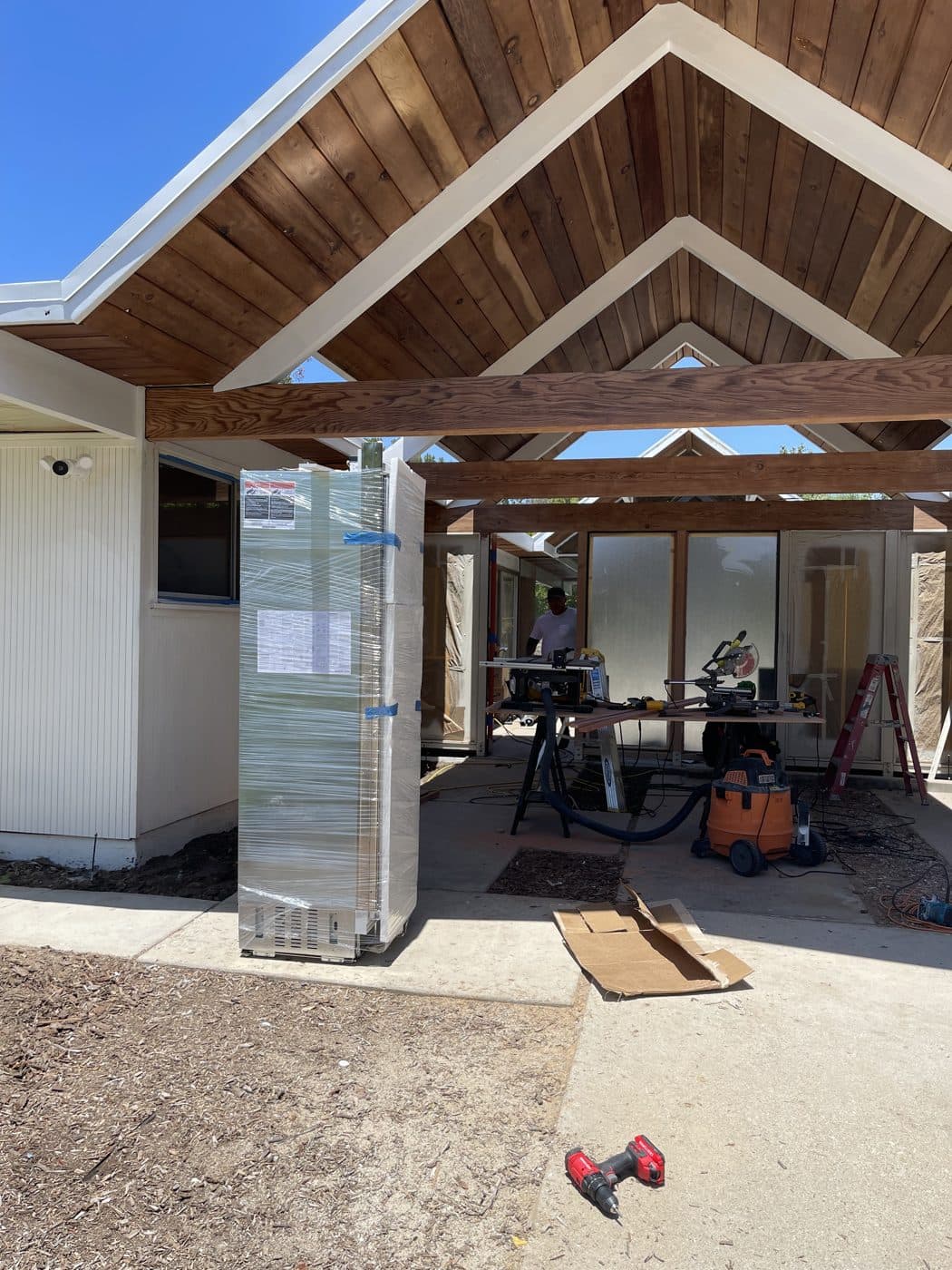
To ship by freight, the appliance needs to be on a pallet, wrapped and strapped, ideally in its original box. Tall, narrow appliances, such as column refrigerators and wine coolers, also need timber bracing to stop them tipping over, which adds to the cost.
Freight is priced by distance and by the delivery service. Delivering to a business with a loading dock costs less than delivering to a home. Home delivery is usually to the curb, using a truck with a liftgate, and the buyer moves the appliance inside. Collecting it from the carrier's terminal is cheapest. Get a quote before you agree on a price, so the buyer knows the total cost. If you consign with us, we arrange the freight.
What to Do With Appliances That Won't Sell
If your appliance isn't worth selling, it can usually still be reused or recycled rather than thrown away.
Donate it. Habitat for Humanity ReStores accept working appliances, and some offer free pickup. Policies vary by store, so call first. You can also give an appliance away through a local marketplace or community group.
Recycle it. Some electric utilities collect old refrigerators and freezers, and pay a small rebate for them. If you're buying a new appliance, the retailer will often haul the old one away. Scrap metal recyclers take most appliances, but refrigerators, freezers and air conditioners contain refrigerant, which a certified technician must remove first. Check your city's rules before you take one in.